Map and Compass Basics
BY STEPHEN C., MGR ODP PROGRAMMING & REGISTERED MAINE GUIDE
Navigating with a map and compass remains one of the most dependable outdoor skills, especially when electronics fail or environmental conditions interfere with GPS. A solid grasp of these fundamentals promotes safety, confidence, and better decision-making in the backcountry. Even if you usually follow blazes and well-marked trails, knowing how to travel with a map and compass is a skill every outdoor explorer should have.
Selecting a Map and a Compass
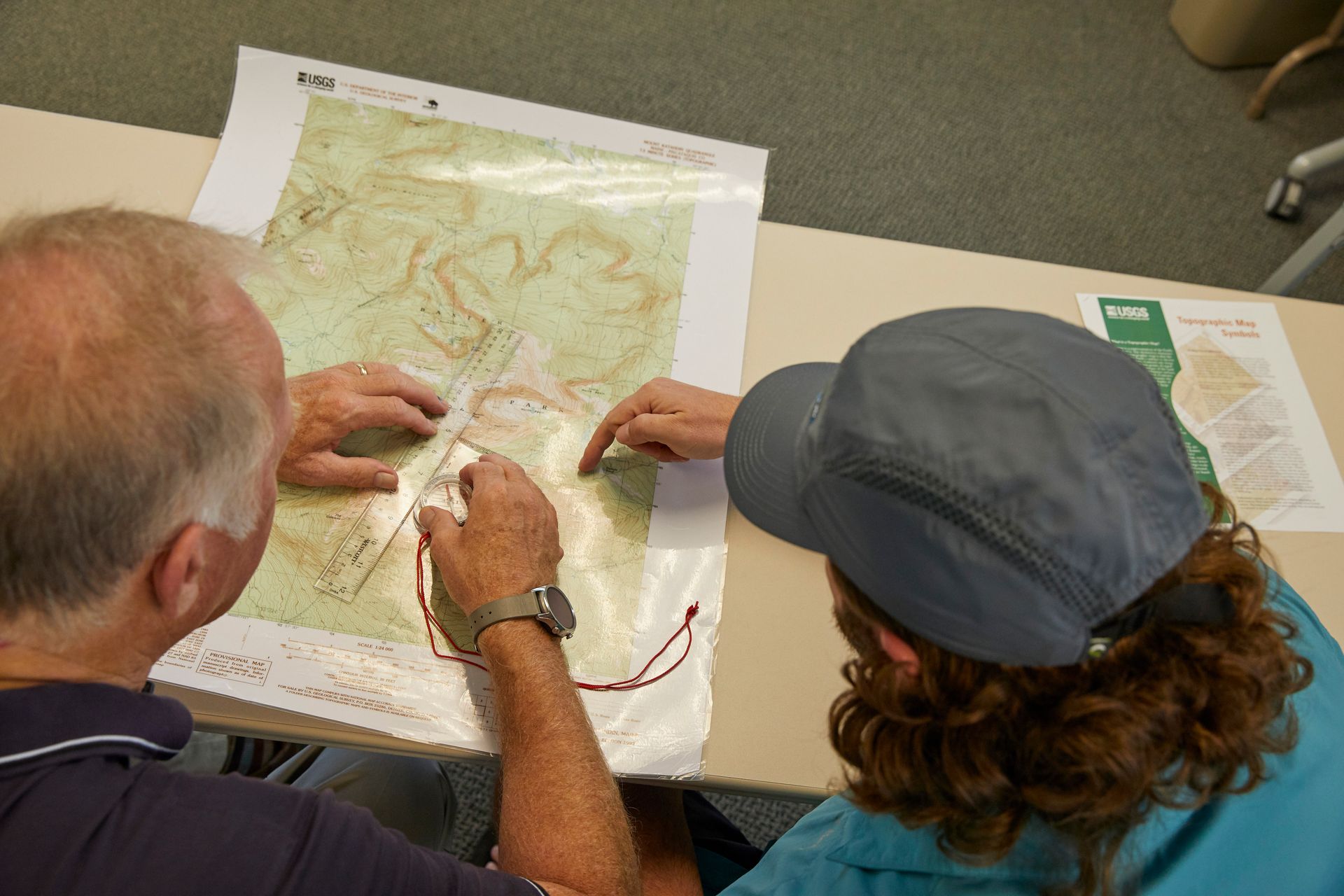
Not all maps are created equal. Choose a map that includes grid lines and clearly notes magnetic declination. Topographic maps are ideal because they show the terrain details you’ll need to navigate confidently with a compass.
As for the compass, a basic baseplate compass is all you need. Make sure the needle swings freely, points to magnetic north, and that the compass is designed for the hemisphere you’ll be traveling in. Some models include glow-in-the-dark markings and a direction-of-travel arrow, which can make quick readings easier, especially when moving over uneven terrain.
Orienting the Map and Identifying Your Location
Before planning any route, orient your map so it matches the landscape around you. Start by laying the map flat, place your compass on it, and rotate the map until the compass needle aligns with north on the map (or with the map’s north-south grid lines, if shown). For instance, when a large hill is on your right side, an oriented map should also display that hill on its right, ensuring that the map's layout aligns with what you see in reality.
To determine where you are, compare visible landmarks around you with features shown on your map. Seek out obvious topographical markers like ridgelines, peaks, roads, open spaces, or bodies of water such as lakes and rivers. For instance, if you're hiking and notice a lake to your north, a mountain peak to the west, and a lengthy ridge to the east, locating these features on your map helps you estimate your position by triangulation.
The Silva 3-Step Technique
A reliable method for planning and following a direction of travel is the classic Silva 3 Step Technique.
1. Set the Map
Align the map with the actual terrain by orienting it to north.
2. Set the Bearing
Place the edge of your compass between your current location and destination on the map. Rotate the compass housing (the ring part of your compass) until its orienting lines match the map’s north grid lines. If traveling from a trail junction to a distant summit, align the compass edge on those two points before adjusting the housing.
3. Follow the Bearing
Hold the compass flat on your palm, turn your body (keeping the compass stationary) until the needle aligns with the orienting arrow, and walk in the direction of travel arrow.
If thick forest blocks your visibility, choose a distant object—like a tree—along the direction-of-travel arrow, walk to it, then pick the next object along the same bearing.
Reading Terrain
Contour lines are essential for understanding both the elevation and the shape of landscapes.
- Lines that are close together show areas with steep slopes.
- Lines spaced far apart suggest more gradual inclines.
- Circles formed by contour lines typically mark hills or depressions—check the elevation to know which.
- “V” shapes in the lines usually point upstream, highlighting valleys or gullies.
Remember: If your intended path has contour lines packed tightly together, you might want to consider a different route to avoid challenging climbs or descents.
Putting it All Together
When you use both a topographic map and a compass:
- Align the map with your current environment
- Pinpoint your location by referencing easily identifiable landmarks or topography
- Establish your direction with the Silva 3-Step method
- Stay on track by choosing visible terrain features along your bearing
- Read contour lines to prepare for crossing valleys and tackling steep sections
By combining these skills, you can travel confidently even in complex terrain.
Like any outdoor skill, map-and-compass navigation takes practice to build comfort and confidence—If you don’t use it regularly, it can fade over time.
Want to keep building your skills? See these navigation methods in action by watching our
How to Use a Map and Compass video, then get some real-world experience at our next
Introduction to Map and Compass Course!